

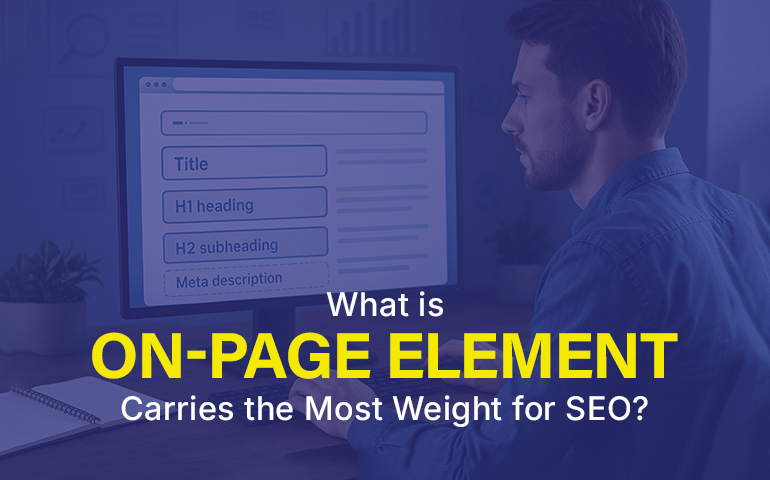
Which On-Page Element Carries the Most Weight for SEO?
In today’s digital world, having a website is not enough. You need people to find it — and for that, Search Engine Optimization (SEO) plays a crucial role. On-page SEO is all about optimizing the elements on your website to improve rankings on Google and other search engines.
The most important on-page element? The short answer is the title tag. But let’s dive deeper.
Why are Title Tags the Most Important On-Page Element?
When it comes to On-Page SEO, title tags are essential. This clickable headline appears in search engine results and tells both search engines and users what your page is about. Behind the scenes, it’s written in your page’s HTML.
Why is the Title Tag So Important for SEO?

- First thing Google reads – helps understand your page’s topic
- Improves click-through rate with well-written titles
- Influences rankings – confirmed SEO ranking factor
- Matches your content with user search intent
Best Practices for SEO Title Tag Optimization
| Practice | Description |
|---|---|
| Include your primary keyword | e.g., “SEO Title Tag Optimization Tips” |
| Keep it under 60 characters | Prevents truncation in search results |
| Write for humans | Make it attractive and click-worthy |
| Add brand name (optional) | Boosts brand recognition |
Examples of Good Title Tags
| Topic | SEO-Friendly Title Tag |
|---|---|
| Digital Marketing Course | Best Digital Marketing Course in India – Join Today |
| Surat SEO Services | Trusted SEO Company in Surat for Small Businesses |
| Yoga Studio in Mumbai | Morning Yoga Classes in Mumbai – Book Free Trial |
Other Important On-Page SEO Elements to Optimize
Meta Descriptions

Meta descriptions are short summaries under the title in search results. Though not a direct ranking factor, they improve CTR by showing value. Keep them under 160 characters, include the main keyword, and focus on benefits.
Content Quality and Keyword Research

Keyword research is the foundation of SEO. Use tools like Google Keyword Planner or SEMrush. Place the main keyword in the first 100 words and sprinkle LSI keywords naturally. Always solve user problems with unique, helpful content.
Heading Tags (H1, H2, H3…)

Heading tags structure your content. Use H1 for the main title, H2 for main sections, and H3 for sub-points. Include keywords naturally and avoid stuffing.
URL Structure

Keep URLs short, meaningful, and keyword-rich. Avoid special characters or unnecessary numbers.
Image Optimization

| Task | Why It Matters |
|---|---|
| Add alt text | Helps Google understand the image |
| Use compressed images | Improves page loading speed |
| Include keywords in alt text | Boosts relevance in image search |
SEO Ranking Factors Beyond On-Page Elements
Don’t forget off-page SEO — like backlinks, social signals, and domain authority. But always start with a strong on-page foundation. Without it, even the best backlinks may not help.
Final Thoughts
While the title tag carries the most weight for on-page SEO, optimizing all elements creates a complete strategy. Think of SEO like cooking: title tags draw attention, meta descriptions boost CTR, headings structure your page, and quality content delivers value.
Doing SEO alone can be overwhelming. As a leading SEO company in Surat, we help small businesses rank, bloggers optimize, and local stores grow. Need help with your title tags or full strategy? Let’s work together.
